Guest Insight — Assoc. Prof. Yüksel İskol, Archaeologist and academic specialist in Anatolian cultural heritage.
Few archaeological sites have entered the global imagination as powerfully as Göbeklitepe.
Its monumental T-shaped pillars, extraordinary animal imagery and remarkable antiquity have transformed the way we think about the communities of the Early Neolithic. Located near Şanlıurfa in southeastern Türkiye, Göbeklitepe belongs to a period stretching broadly from the tenth to the ninth millennia BCE — a time when human communities across Upper Mesopotamia were undergoing profound changes in settlement, subsistence, social organisation and symbolic expression.
Yet perhaps the most important thing Göbeklitepe teaches us is not what we know.
It is how much remains open to interpretation.
For archaeology, uncertainty is not a weakness. It is the space in which knowledge develops.
The Power — and Danger — of a Simple Story
Göbeklitepe is often introduced through a series of dramatic statements.
The world’s first temple.
A sanctuary built by hunter-gatherers.
The place where religion came before agriculture.
The site that rewrote human history.
Such phrases are memorable. They have also played an important role in bringing international attention to the archaeology of southeastern Anatolia.
But archaeology rarely develops through simple conclusions.
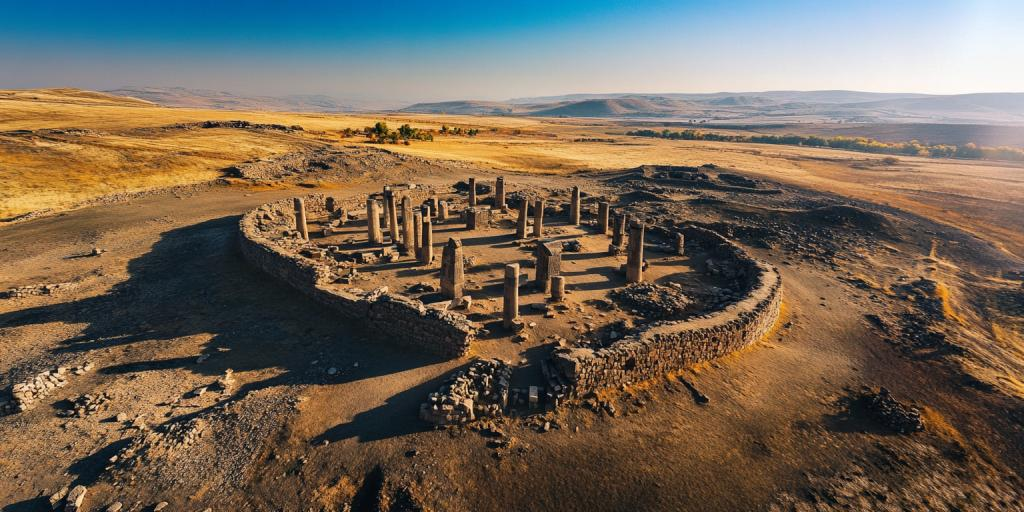
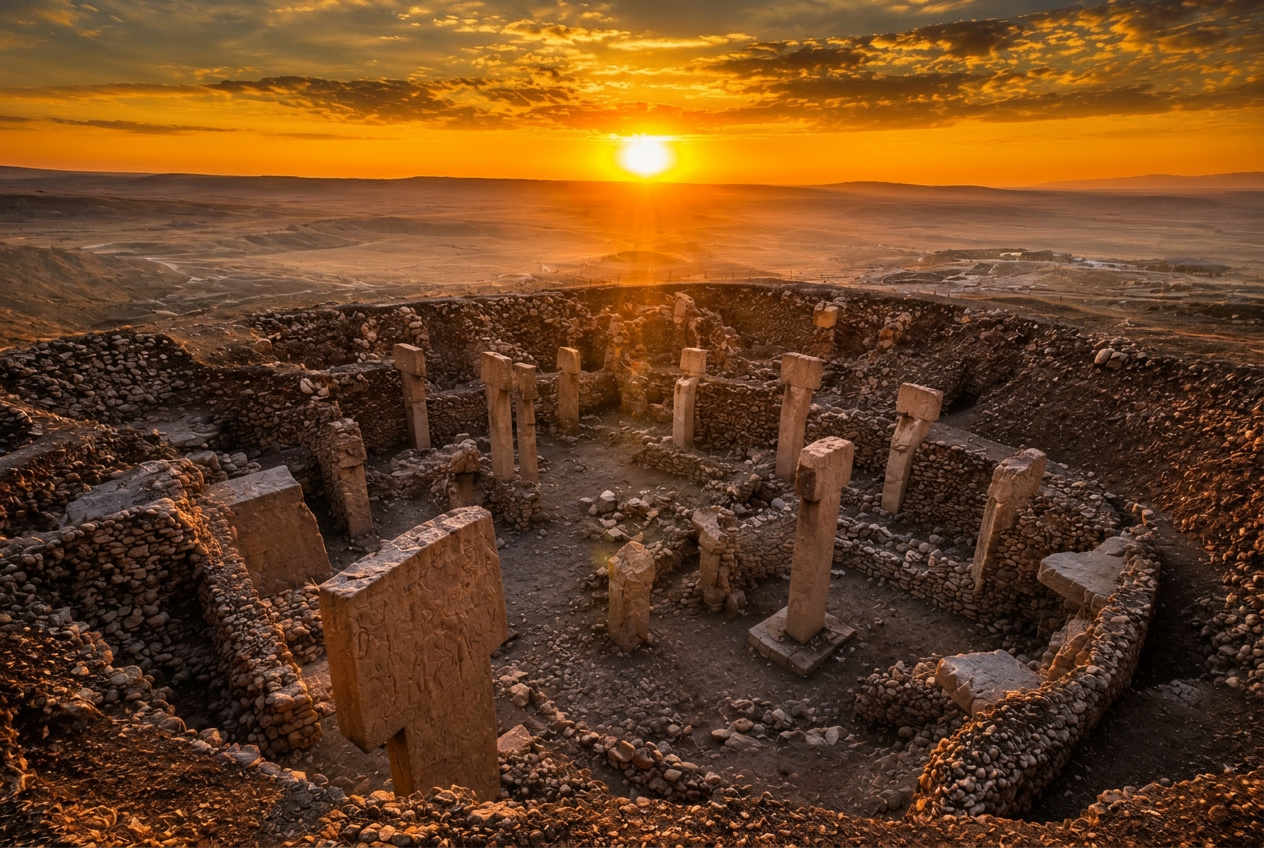
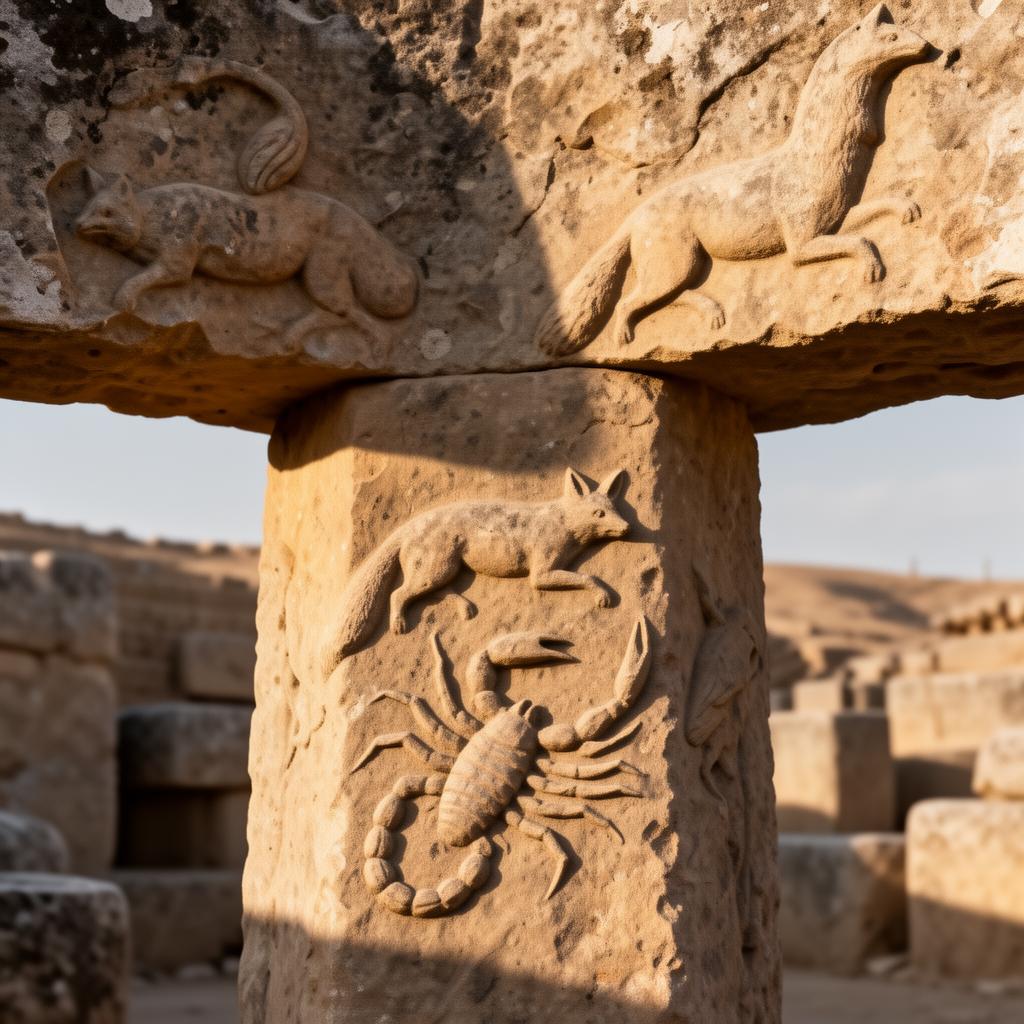
The first decades of research at Göbeklitepe understandably emphasised the remarkable monumental buildings that dominated the excavated areas. Large circular and oval structures contained monumental limestone pillars, some reaching approximately 5.5 metres in height. Many carried reliefs of foxes, snakes, wild boar, birds and other animals, while several pillars also displayed arms, hands, belts and clothing — suggesting that the T-shaped forms themselves may represent highly abstracted human figures.
Against the archaeological expectations of the time, this was extraordinary.
Göbeklitepe therefore came to be understood primarily as a ritual gathering place: a sanctuary or ceremonial centre visited by communities that did not necessarily live there permanently.
Today, that interpretation is more complex.
Recent research has identified evidence for domestic activities and indications of permanent occupation. The German Archaeological Institute now describes Göbeklitepe not simply as a ritual sanctuary, but as a settlement with a particularly pronounced ritual component.
This change is important.
It does not diminish Göbeklitepe.
It makes it more interesting.
Was Göbeklitepe Really the “First Temple”?
The expression “world’s first temple” has become almost inseparable from Göbeklitepe.
But the word temple carries assumptions inherited from much later societies: organised priesthoods, recognised deities, institutional religion and a clear separation between sacred and everyday space.
We cannot automatically project these concepts back more than eleven thousand years.
There are no written texts from Göbeklitepe explaining who the pillars represented, what ceremonies took place within the buildings or how the people who constructed them understood the distinction between ordinary and sacred life.
Even the distinction itself may be misleading.
In many traditional societies, ritual, domestic life, food production, burial, memory and social identity are not neatly divided into the categories familiar to the modern world.
For this reason, terms such as communal buildings, special-purpose buildings or monumental structures are often more cautious archaeological descriptions.
The question is therefore not whether Göbeklitepe was “religious” or “domestic.”
It may have been both — and much more.
Monument Builders Were Also People Living Everyday Lives
One of the most persistent ideas surrounding Göbeklitepe is the contrast between monumental architecture and the hunter-gatherer world.
How could communities without cities, writing or established state institutions organise the labour required to quarry, transport, carve and erect enormous stone pillars?
The question itself reveals one of the biases archaeology has gradually learned to challenge.
Complex architecture does not necessarily require a state.
Sophisticated symbolic systems do not require writing.
Large-scale cooperation does not require kings.
The construction of Göbeklitepe certainly required planning, technical knowledge, coordination and collective labour.
But precisely how that labour was organised remains unknown.
Were certain individuals responsible for coordinating construction?
Did different communities contribute to individual buildings?
Were specialists responsible for carving particular images?
Did gatherings occur seasonally?
Were monumental projects connected to feasting, exchange, marriage networks, ancestor traditions or territorial relationships?
Archaeology can offer hypotheses.
It cannot yet provide final answers.
The Silent Figures of Göbeklitepe
Perhaps nowhere is this uncertainty more powerful than in the T-shaped pillars themselves.
The imagery is extraordinary.
Snakes appear repeatedly. Foxes, wild boar, birds and other animals occupy the surfaces of pillars and stone objects. Some compositions appear carefully organised rather than randomly decorative.
The pillars at the centre of several monumental buildings are particularly striking.
Their arms and hands establish an anthropomorphic quality, yet they are often faceless.
They are human-like, but not portraits.
They occupy architectural space, yet they may simultaneously represent beings, ancestors, identities or concepts that remain beyond our ability to name.
A major 2026 study of the imagery from Göbeklitepe emphasises the importance of understanding these representations within their architectural and archaeological context and considers several possible interpretive frameworks rather than reducing them to a single explanation.
This is essential.
A fox does not automatically have one symbolic meaning.
A vulture is not a dictionary entry.
A snake represented eleven thousand years ago cannot simply be interpreted through the mythology of civilizations that appeared thousands of years later.
Archaeological interpretation begins with context.
And context demands restraint.
The Dead Are Changing the Story Again
One of the most fascinating examples of how Göbeklitepe continues to change came only recently.
For many years, fragmented human bones recovered from deposits at the site contributed to discussions about ritual practices, the treatment of the dead and possible secondary burial traditions.
In September 2026, Julia Gresky and Lee Clare published research on the first two intact burials identified at Göbeklitepe. These burials, dating to the Pre-Pottery Neolithic B period, included human remains placed beneath or associated with buildings. Their analysis suggests that at least some of the fragmented human bones found elsewhere at the site may have originated from burials later disturbed and redeposited through natural processes.
This does not close the debate about mortuary practices at Göbeklitepe.
The researchers themselves emphasise that additional forms of treatment of the dead cannot be excluded.
But it demonstrates something fundamental about archaeology:
A discovery does not simply add another object to what we already know.
Sometimes it changes the questions.
Göbeklitepe Was Not Alone
Another major change in our understanding comes from looking beyond Göbeklitepe itself.
For many years, the site appeared almost isolated in its magnificence.
Today, research across the Şanlıurfa region — particularly within the broader Taş Tepeler landscape — allows Göbeklitepe to be viewed as part of a much wider Early Neolithic world.
Karahantepe, Sayburç, Sefertepe, Çakmaktepe and other sites reveal communities experimenting with architecture, imagery, settlement and social organisation across the region.
This may ultimately prove to be one of the most significant developments in Neolithic archaeology.
The question is no longer simply:
Why was Göbeklitepe built?
We must also ask:
What kind of world made Göbeklitepe possible?
That world extended across Upper Mesopotamia.
Its communities knew one another.
Ideas travelled.
Images were shared and transformed.
Architectural traditions developed across generations.
And somewhere within this landscape, the long transition toward settled life, cultivation and eventually agriculture was unfolding.
Did Religion Create Agriculture?
One of the most famous interpretations associated with Göbeklitepe suggested that the need to construct and maintain ritual centres may have helped encourage permanent settlement and, eventually, food production.
It was a provocative reversal of an older model.
Rather than agriculture producing civilisation and then religion, perhaps powerful social and ritual networks helped create the conditions that encouraged agriculture.
The idea remains influential.
But again, a single causal explanation is unlikely to describe a transformation that unfolded across many communities and over many generations.
The transition from mobile hunter-foraging societies toward increasingly sedentary communities and food production was not one event.
Nor was it invented at one archaeological site.
Göbeklitepe occupied an important place within this transformation, but understanding Neolithisation requires examining environmental change, plant and animal exploitation, settlement patterns, social networks, technology, ritual life and demographic developments together.
Göbeklitepe belongs within this larger story.
It does not need to be the sole cause of it to be extraordinary.
What, Then, Do We Know?
We know that communities in Upper Mesopotamia were capable of monumental construction at an extraordinarily early date.
We know that sophisticated systems of imagery existed before writing.
We know that large groups could cooperate in ambitious architectural projects long before the emergence of cities and states.
We know that the distinction between hunter-gatherer and settled community was considerably more complicated than earlier models once suggested.
And we increasingly understand that Göbeklitepe was connected to a broader cultural landscape whose archaeology is only now becoming visible in greater detail.
But we still do not know the names of the people who gathered there.
We do not know what they called the beings represented on the pillars.
We do not know what stories accompanied the animals carved into stone.
We do not know what was spoken, sung or remembered inside the monumental buildings.
We do not know precisely how authority worked.
We do not know whether the central pillars represented ancestors, supernatural beings, mythical figures or categories for which modern language has no equivalent.
And perhaps we should resist the temptation to fill every silence.
The Importance of Not Knowing
Visitors often arrive at Göbeklitepe expecting answers.
Archaeology offers something more valuable.
It offers evidence.
The difference matters.
Evidence allows us to reconstruct parts of the human past while remaining conscious of the boundary between what can be demonstrated and what can only be proposed.
Göbeklitepe has already changed considerably in archaeological interpretation since excavations began in 1995. Research continues, new discoveries emerge, and the surrounding Taş Tepeler landscape is expanding the frame through which the site is understood.
Our understanding ten years from now will almost certainly be more detailed than it is today.
That is not a failure of archaeology.
That is archaeology working exactly as it should.
Göbeklitepe is extraordinary not because it gives us a simple answer to the origins of civilisation.
It is extraordinary because it allows us to stand at one of the great thresholds of human history and observe a world in transformation.
To encounter Göbeklitepe responsibly is therefore not simply to stand before its stones.
It is to understand the questions archaeologists are still asking of them.
And sometimes, the most meaningful encounter with the past begins by admitting what we do not yet know.
Guest Insight — Assoc. Prof. Yüksel İskol
Archaeologist and academic specialist in Anatolian cultural heritage. His work and academic interests focus on the archaeology and cultural heritage of Anatolia and Upper Mesopotamia, with particular attention to the interpretation and preservation of archaeological landscapes.
Sources & Further Reading
- UNESCO World Heritage Centre — Göbekli Tepe (World Heritage List entry 1572)
- German Archaeological Institute (DAI) — Göbekli Tepe research project
- German Archaeological Institute (DAI) — publication on the imagery of Göbekli Tepe (2026)
- Gresky, J. & Clare, L. (2026). Intact burials and mortuary practices at Göbekli Tepe. PLOS ONE, September 2026.