Guest Insight — Assoc. Prof. Yüksel İskol, Archaeologist and academic specialist in Anatolian cultural heritage.
Before the City
Public conversation about Göbeklitepe and Karahantepe often returns to a single question: which site is the oldest? It is an understandable question, and chronology matters. Yet it is rarely the most rewarding one. A more productive question, and the one that occupies much of the current research in Upper Mesopotamia, is what these monumental places may tell us about collective life before cities, before states, and long before writing.
The sites of the Taş Tepeler belong to a world without urban institutions. There are no palaces, no administrative archives, no evident hierarchy recorded in text. What survives is architecture, carved imagery, worked stone and the patterned traces of people gathering, building and returning. From this material, archaeologists attempt to reconstruct something far more difficult than a date: the shape of early community.
Monumental Architecture as Social Action
Quarrying, shaping, transporting and raising multi-tonne limestone pillars is not an individual act. It requires planning, shared labour, the provisioning of workers and an accepted reason to begin. Whatever meaning these structures carried, their construction was in itself a social process, and the evidence increasingly points to coordination across groups rather than the effort of a single small household community.
This is why archaeologists often describe monumental building of this period as social action rather than simply as religious architecture. The word temple, which appeared frequently in early popular accounts, carries assumptions about formal institutions, priesthoods and doctrine that the surviving evidence does not establish. It is safer, and more accurate, to say that these were places of gathering with strong symbolic significance, and that their precise function remains debated.
Gathering Before Urban Life
One interpretation, widely discussed, is that such places drew people together periodically from a wider territory: for building, for feasting, for ritual observance, for exchange of materials, ideas and marriage partners. Faunal remains and the scale of some structures may suggest episodes of large communal consumption, although the frequency and character of these events are still under study.
What deserves emphasis is that community, in this sense, need not mean a city. Coordinated construction and shared symbolic traditions can exist without permanent centralised authority. Recent work at Karahantepe and other Taş Tepeler sites has also shown domestic and residential elements alongside monumental ones, which complicates any simple division between sanctuary and settlement.
Memory in Stone
Stone is durable, and durability has social consequences. A raised pillar remains visible to those who did not witness its raising. A carved animal or human figure can be returned to, referred to and reinterpreted across generations. In societies without writing, monumental architecture and fixed imagery may function as an anchor for shared memory.
The deliberate treatment of these structures reinforces the impression of intentional continuity. Buildings were repaired, rebuilt, modified and, in some cases, filled in. Whether such filling represents ritual closure, practical reconstruction or something else entirely is still debated. What is clear is that these were not casually abandoned spaces.
Shared Traditions, Local Differences
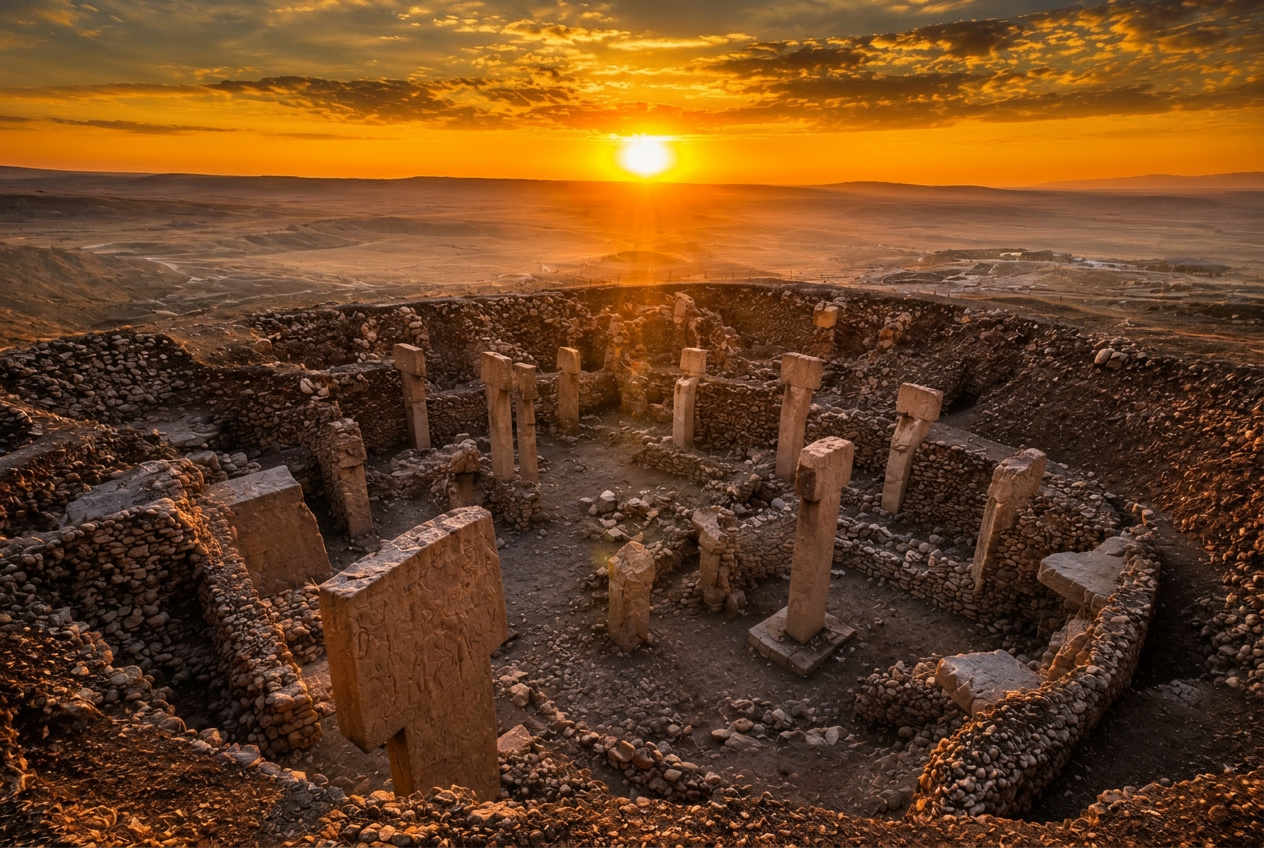
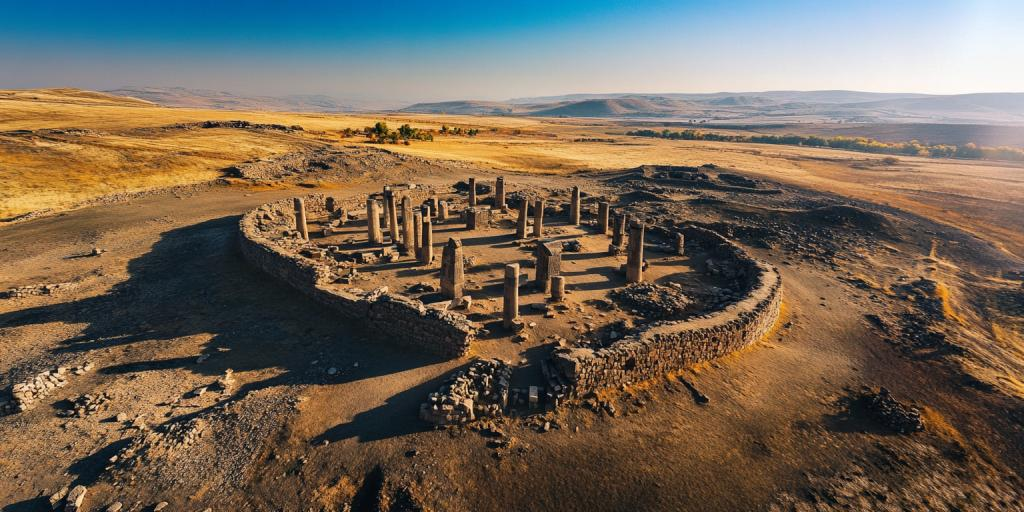
Across the Taş Tepeler, certain elements recur: T-shaped pillars, animal imagery, carefully organised communal spaces, particular ways of working stone. This repetition across a landscape of separate sites indicates a shared symbolic and technical tradition rather than a series of unconnected local experiments.
Yet the differences are equally instructive. Göbeklitepe is dominated by circular enclosures and relief-carved animals; Karahantepe has yielded rock-cut chambers and a striking emphasis on the human form in three dimensions. Other sites in the region present their own configurations. One reading is that we are seeing local expressions of a common framework, in the way that neighbouring communities may share a language while speaking distinct dialects.
A Landscape Rather Than a Single Site
For this reason, the Taş Tepeler are best approached as a landscape rather than as a set of isolated monuments. The distribution of sites across the limestone hills around Şanlıurfa, at distances that can be walked in a day or less, suggests a network of interrelated places rather than one centre with peripheries.
This regional perspective also matters for the longer story. Upper Mesopotamia is one of the areas where the long transitions toward settled life, cultivation and animal management can be traced over millennia. These processes were gradual, uneven and regionally varied. It would be a mistake to describe them as a single revolution with a single cause, or to treat monumental gathering places as the direct trigger of agriculture. The relationship between social gathering, subsistence change and later village societies remains one of the central research questions of the region.
Why the Question of “Community” Matters
If we ask only which site is oldest, we learn a number. If we ask how people organised themselves, we begin to approach the question of how human societies became capable of sustained cooperation at a scale beyond the immediate group.
The evidence from the Taş Tepeler may suggest that shared symbolic frameworks, communal labour and places of collective memory were part of that development well before urban institutions existed. That reframing is significant. It moves the origin of complex social life away from the city and toward practices of gathering, building and remembering.
Archaeology Without Final Answers
It is important to be candid about the limits of interpretation. We do not know what these communities believed. We do not know whether authority was held by particular individuals, by lineages, by ritual specialists, or distributed in ways that leave no clear archaeological signature. Archaeologists continue to debate the function of the enclosures, the meaning of the imagery and the social structures behind the labour.
Excavation in the region is ongoing, and interpretations have already shifted more than once as new evidence has emerged. A responsible account of these sites is therefore provisional by design. That is not a weakness of the discipline; it is how the discipline works.
Why Seeing Göbeklitepe, Karahantepe and the Museum Together Matters
For a visitor, the intellectual value of the region lies in combination rather than in any single stop. The three principal elements answer different parts of the same question.
- Göbeklitepe presents monumental architecture at landscape scale, and makes the organisation of communal building legible.
- Karahantepe shows rock-cut space and the human figure, and demonstrates how varied the tradition could be within one region.
- The Şanlıurfa Archaeology Museum holds the excavated objects and sculpture, which cannot be read properly while still in the ground.
Seen separately, each offers a fragment. Seen together, over two unhurried days, they allow a visitor to move between landscape, architecture and object, and to understand why interpretation here remains open.
The stones of the Taş Tepeler do not tell us what these people believed. They tell us that, more than eleven thousand years ago, communities in Upper Mesopotamia were capable of working together, of building for more than shelter, and of leaving something intended to be remembered. That, before any city existed, is already a considerable statement.
Guest Insight — Assoc. Prof. Yüksel İskol
Archaeologist and academic specialist in Anatolian cultural heritage. His work and academic interests focus on the archaeology and cultural heritage of Anatolia and Upper Mesopotamia, with particular attention to the interpretation and preservation of archaeological landscapes.