When German archaeologist Klaus Schmidt cleared the first T-pillar at Göbeklitepe in 1995, the textbook chronology of human civilisation cracked open. A generation later, fifteen kilometres south on the same limestone ridge of the Taş Tepeler, the chamber of statues at Karahantepe is doing it again. Travellers ask us the same question almost every week: if I only have one day in Şanlıurfa, which one should I see? The honest answer is both — and here is why.
The shared world: the Taş Tepeler
Göbeklitepe and Karahantepe are not rival sites. They are two members of a family of at least a dozen Pre-Pottery Neolithic sanctuaries scattered across the limestone hills around Şanlıurfa — collectively known in Turkish archaeology as the Taş Tepeler (the Stone Hills). They were built and used between roughly 9600 and 8000 BCE, before pottery, before metal, before the wheel, and long before the first cities of Mesopotamia rose on the plain below.
Göbeklitepe: the discovery that rewrote prehistory
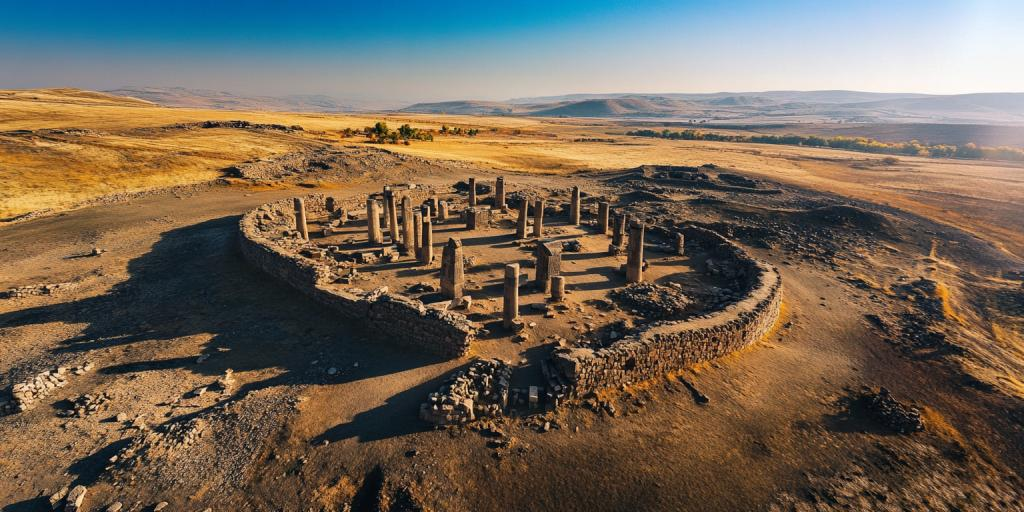
Göbeklitepe is the elder sibling in the public imagination. UNESCO inscribed it as a World Heritage Site in 2018. Its great circular enclosures — A, B, C, D — are dominated by paired central T-pillars up to 5.5 metres tall, surrounded by a ring of smaller pillars set into a bench. The carvings are a bestiary in stone: foxes, scorpions, vultures, snakes, wild boar, aurochs. The pillars themselves are widely understood as stylised human figures — abstracted ancestors, perhaps, or guardians.
- Built and used c. 9600–8200 BCE — roughly 7,000 years older than Stonehenge.
- Excavated since 1995, opened to the public under a striking architectural canopy in 2018.
- Six monumental enclosures are visible today; geophysics suggests at least twenty more lie beneath the mound.
- The site was deliberately buried by its builders at the end of its use — a riddle archaeology has not yet solved.
Karahantepe: the chamber of statues
Karahantepe was first surveyed in 1997 but only began systematic excavation in 2019 under the Turkish Ministry of Culture's Taş Tepeler Project. What has emerged since is, if anything, more startling than Göbeklitepe. Where Göbeklitepe gave us animals in relief, Karahantepe is giving us people — fully three-dimensional, life-sized human figures carved from the living bedrock.
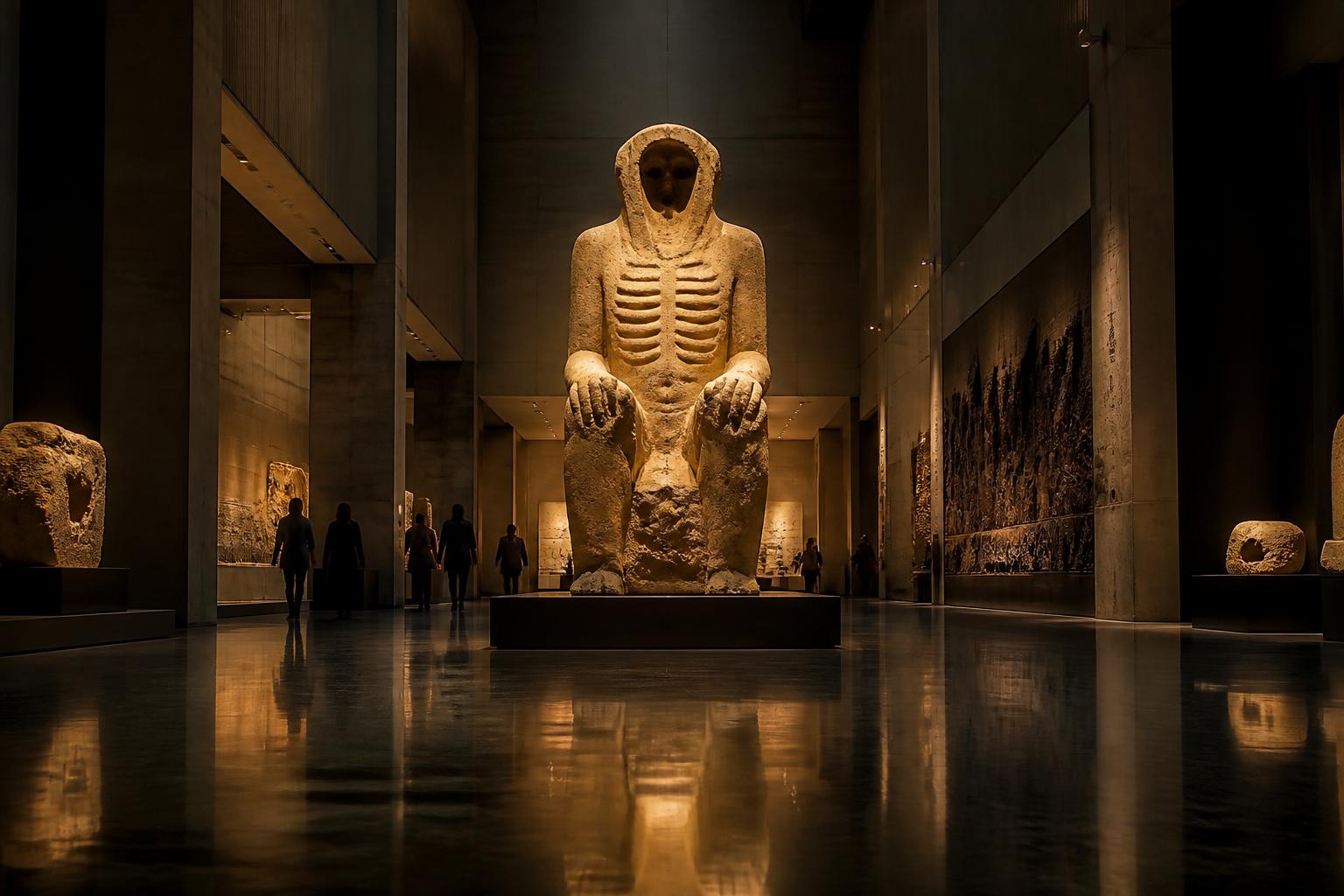
The most photographed find is the Karahantepe "chamber" — a rock-cut room with eleven phallic pillars rising from the floor, watched from a niche by a single human head with hooded, serpent-like eyes. Above the chamber, the most famous statue of all was lifted in 2023: a 2.3-metre seated male figure with skeletal ribs and gripping hands, now in the Şanlıurfa Archaeology Museum. It is one of the most remarkable life-sized human statues known from the early Neolithic.
Göbeklitepe vs Karahantepe at a glance
Architecture
Göbeklitepe is round: enclosed circles with paired central pillars, a public-facing monumentality. Karahantepe is angular and intimate: rectilinear rooms, deep rock-cut chambers, narrow passageways. If Göbeklitepe is a cathedral, Karahantepe is a crypt.
Imagery
Göbeklitepe speaks in animals carved in relief on flat pillar faces. Karahantepe speaks in the human body — in the round, almost shockingly figurative for the period. Both belong to the same symbolic universe, but the dialect is different.
Visitor experience
Göbeklitepe is fully equipped: a visitor centre, a tensile-fabric canopy over the main enclosures, a wooden walkway loop, an electric shuttle from the car park. Karahantepe is rawer: open sky, fewer barriers, a working dig you can feel the dust of. Both are wheelchair-accessible along their main routes.
Crowds and time of day
Göbeklitepe is busiest between 10:00 and 14:00, when coach tours from Gaziantep arrive. The light is best at first opening (around 08:00 in summer) and in the final hour before sunset, when the carvings on the southern faces of the pillars come alive. Karahantepe receives a fraction of the visitors, and the late afternoon light across the bedrock chambers is unmatched.
How to visit both in one day
The two sites are only a 35-minute drive apart, both south of Şanlıurfa city. The choreography that works best, in our experience designing private days here, is this:
- 08:00 — Arrive at Göbeklitepe at opening, before the air heats and the tour coaches arrive.
- 10:30 — Drive south through pistachio groves to Karahantepe; the road itself is part of the experience.
- 11:00 — Privately guided Karahantepe visit with a licensed professional guide and expert-led interpretation, subject to current site opening conditions and regulations; allow at least 90 minutes for the chamber and the upper terraces.
- 13:30 — Late lunch of çiğ köfte and Urfa kebab in the old city, ideally in a stone-vaulted courtyard.
- 16:00 — The Şanlıurfa Archaeology Museum to meet the Karahantepe seated statue face-to-face. This is the moment the day clicks into place.
Practical notes
- Tickets: combined museum passes such as Müzekart+ are commonly used for the sites and the museum. Ticketing, opening hours and admission rules can change; current arrangements are confirmed during journey planning.
- Best months: late March through mid-June, and mid-September through early November. July and August are punishingly hot.
- Photography: tripods and drones generally require advance official permission, which is granted at the discretion of the authorities. Current rules are confirmed during journey planning.
- Guides: the on-site guides at Göbeklitepe are good; for Karahantepe, a licensed professional guide with expert-led interpretation is the difference between a visit and an understanding.
Sequenced this way, the day builds rather than repeats: the open enclosures of Göbeklitepe in the morning light, the enclosed chamber at Karahantepe in the late afternoon, and the seated statue in the museum at the end — the moment the landscape and its imagery finally meet.
Plan your day with Sumera
Our private journeys through the Taş Tepeler combine Göbeklitepe, Karahantepe and Şanlıurfa's archaeological collections with licensed professional guiding, expert-led interpretation and carefully coordinated visits. Any specialist meeting or enhanced arrangement is subject to official permission, site regulations and availability. If you'd like us to design it for your dates, we are a message away.