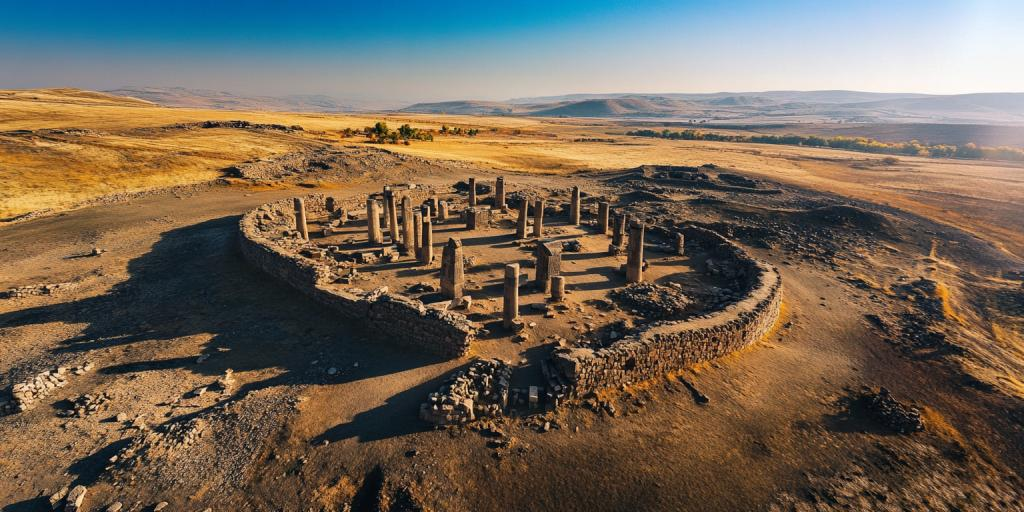
The Şanlıurfa Archaeology Museum is, by surface area, the largest archaeology museum in Turkey — and, by importance of holdings, arguably one of the most consequential in the world. It is the place where the Taş Tepeler come to rest: the place where the original carvings lifted from Göbeklitepe and Karahantepe live, where one of the most remarkable life-sized human statues known from the early Neolithic stands waiting for you in a dim hall, and where a single afternoon can compress the last twelve thousand years of human story into a slow, deliberate walk.
Most visitors come to Şanlıurfa for the hills. They are right to. But it is the museum — visited at the right hour, in the right order, ideally on the same day as Karahantepe — that turns a sightseeing trip into something that stays with you for the rest of your life.
A museum built for the discoveries it holds
The current museum complex opened in 2015 on the western edge of Haleplibahçe Park, replacing a much smaller building that had become impossible to expand. It was designed from the outset around two ideas: that the Şanlıurfa region would keep producing world-changing finds, and that those finds deserve architecture quiet enough to disappear behind them. The result is a long, low, deeply restrained building of local limestone and oxidised steel — a shell built to let the stones speak.
- Total floor area of roughly 60,000 m² across the museum and the adjoining Haleplibahçe Mosaic Museum.
- Over 10,000 artefacts on permanent display, from the Pre-Pottery Neolithic to the late Ottoman period.
- Three exhibition levels arranged in strict chronological order, beginning with the Taş Tepeler and ending with Islamic Şanlıurfa.
- A dedicated children's archaeology wing and a working conservation lab visible from the upper gallery.
The room you came for: the Karahantepe seated statue
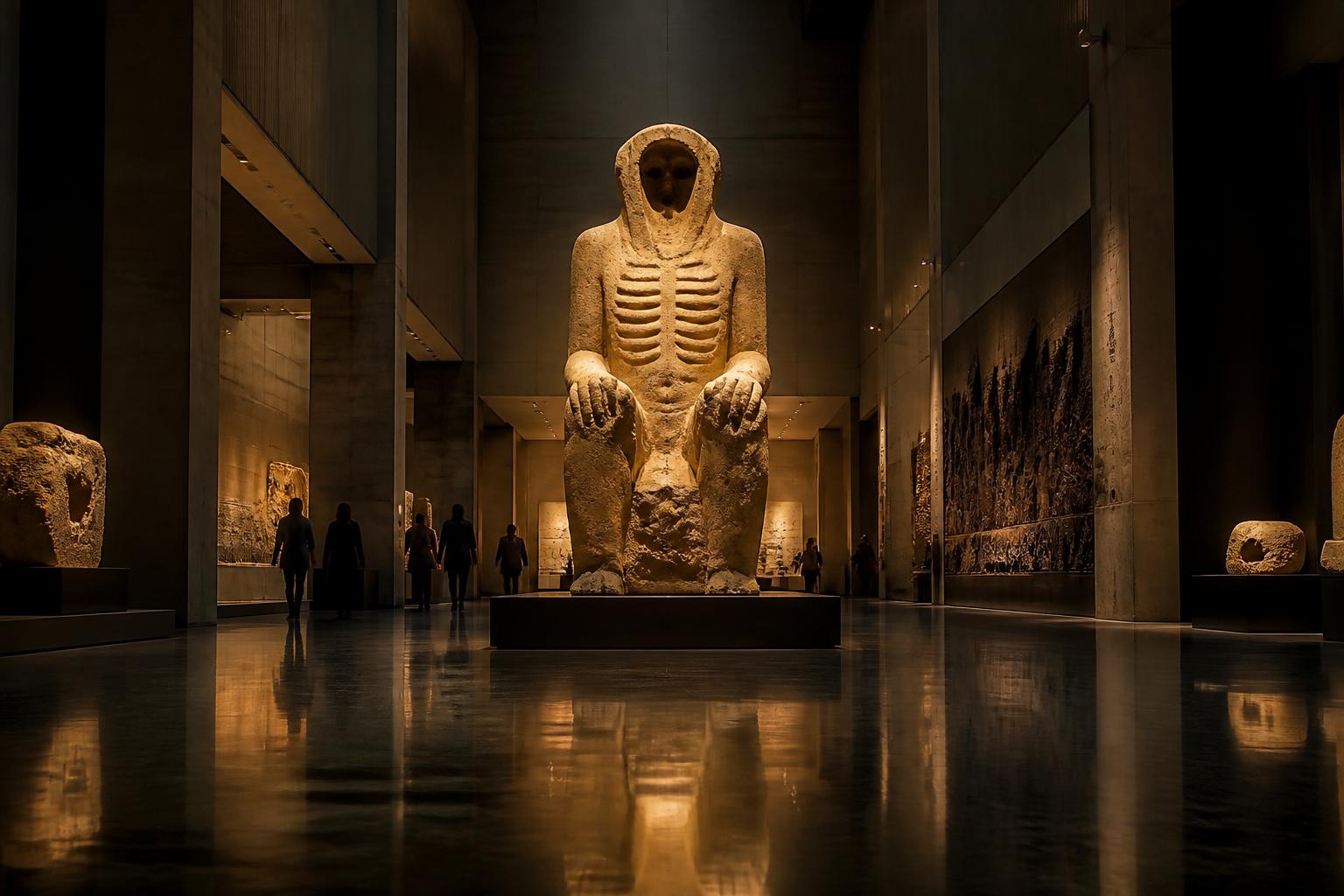
Walk past the ticket hall, through the introduction gallery, and the building opens into a tall, deliberately dim hall. At the centre, on a low dark plinth and lit by a single warm spotlight, stands the figure that more than any other has made this museum a pilgrimage site for archaeologists: the seated male statue lifted from Karahantepe in 2023. He is 2.30 metres tall, carved from a single block of local limestone, his ribs picked out in shallow relief, his hands gripping his own thighs, his hooded eyes staring straight ahead. He is, at roughly 11,000 years old, one of the most remarkable life-sized human statues known from the early Neolithic.
Nothing in the room competes with him. The lighting is engineered so that you cross the threshold, see him in silhouette, and walk the full length of the hall before his face resolves. Most visitors are silent by the time they reach him. Take your time. The bench behind you is there for a reason.
The hall of T-pillars
From the seated statue, the route opens into the great Neolithic gallery — a long, columnar hall lined with original T-pillars from Göbeklitepe and the surrounding Taş Tepeler sites. The pillars at the sites themselves are, in many cases, replicas; the originals were lifted into climate-controlled storage to protect the relief carvings. This is where they live now.
Read the pillars from base to capital. The animals — foxes mid-stride, snakes coiling vertically, scorpions splayed, vultures in profile — are carved with a fluency that genuinely does not seem possible for hands that had not yet invented pottery. Look for the belts, the arms folded against the stone, the hands meeting at the front: these pillars are not architectural columns. They are stylised human bodies. You are walking through a crowd of ancestors.
The Haleplibahçe mosaics — the other half of the museum
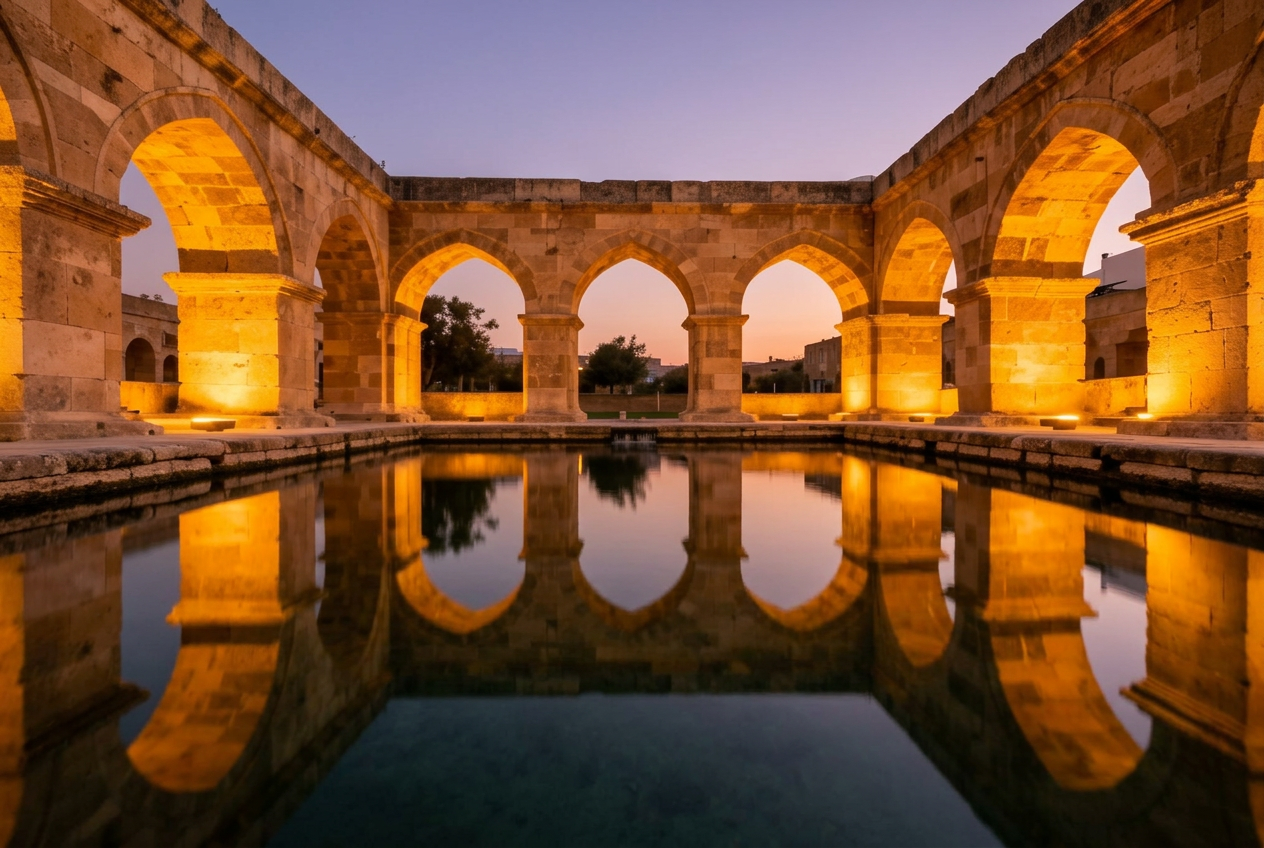
Connected to the main museum by a covered walkway, the Haleplibahçe Mosaic Museum is built directly over the late Roman / early Byzantine villa complex where its mosaics were unearthed between 2006 and 2008. You walk above them on a glass and steel platform; the floor of the ancient triclinium is six metres below your feet, exactly where it was found.
The masterpiece is the so-called "Amazon Queens" mosaic: a panoramic frieze of four mounted Amazon warriors — Hippolyta, Penthesilea, Melanippe and Thermodosa — riding down lions and panthers in a stylised mountain landscape. The colour palette has barely faded in fifteen centuries. Allow at least thirty minutes here, separate from the main museum visit.
How to walk the museum (our suggested route)
The museum is laid out chronologically, but the emotional arc works best in a slightly different order. This is how we choreograph the visit on a privately guided day with expert-led interpretation:
- Begin at the Karahantepe seated statue hall — go straight to him before the day's energy is spent.
- Move into the T-pillar gallery and read three or four pillars closely rather than skimming all of them.
- Cross the upper bridge to the small finds galleries: obsidian blades, beaded necklaces, the bone flute fragments from Körtik Tepe.
- Descend to the Bronze Age and Hittite rooms — keep the pace brisk; this is context, not climax.
- Continue through the Assyrian, Hellenistic, Roman and Byzantine halls; pause at the Edessa mosaics.
- End in the covered walkway to the Haleplibahçe Mosaic Museum; the Amazon hunt is the visual exhale after the prehistoric hush.
When to go
Opening hours vary seasonally. We confirm current museum hours during journey planning; early visits and the later part of the public visiting day can often provide a quieter atmosphere.
If you can choose, visit on the same day as Karahantepe rather than splitting them. Walking out of the chamber on the hill at 14:00 and meeting the seated statue at 16:00 — in that order — is the choreography that makes both unforgettable. We design our private Taş Tepeler journeys around exactly this arc.
Practical notes
- Combined museum passes such as Müzekart+ are commonly used across the Archaeology Museum, the Haleplibahçe Mosaic Museum, Göbeklitepe and Karahantepe. Ticketing, opening hours and admission rules can change; current arrangements are confirmed during journey planning.
- Holiday schedules and opening days can change; current arrangements are confirmed during journey planning.
- Photography and professional-equipment rules can change; current museum regulations are confirmed during journey planning.
- Allow a minimum of two and a half hours; serious archaeology travellers should budget half a day.
- The on-site café is decent for a coffee but underwhelming for lunch — we route guests to a stone-vaulted courtyard in the old city instead.
- Wheelchair-accessible throughout, including the glass platform over the Haleplibahçe excavations.
What few visitors notice
Three quiet rooms reward the slow visitor. The Körtik Tepe room, upstairs and easy to miss, holds chlorite vessels carved with scorpions and snakes that predate Göbeklitepe by several centuries. The Harran corner gathers cuneiform tablets recovered from the moon-god Sin's temple precinct — the same ground Abraham is said to have walked. And the small Sumatar gallery preserves stelae of the old Şanlıurfa pagan kingdoms, with inscriptions in the Edessene dialect of Aramaic. Ask the guards; they are proud of them.
The seated statue rewards a second visit at the end of the walk. Seen after the halls that explain its context, the figure reads less as an artefact behind glass and more as a deliberate portrait — an extraordinary early attempt to render the human form at life size.
Plan your museum hour with Sumera
We arrange privately guided museum visits with licensed professional guides and expert-led interpretation. If you would like the collection walked in the order that does it justice — and to see the seated statue with expert-led interpretation — write to us. Special access arrangements are subject to official permissions, availability and site regulations.